- Rating
- —/10
- Read
- —
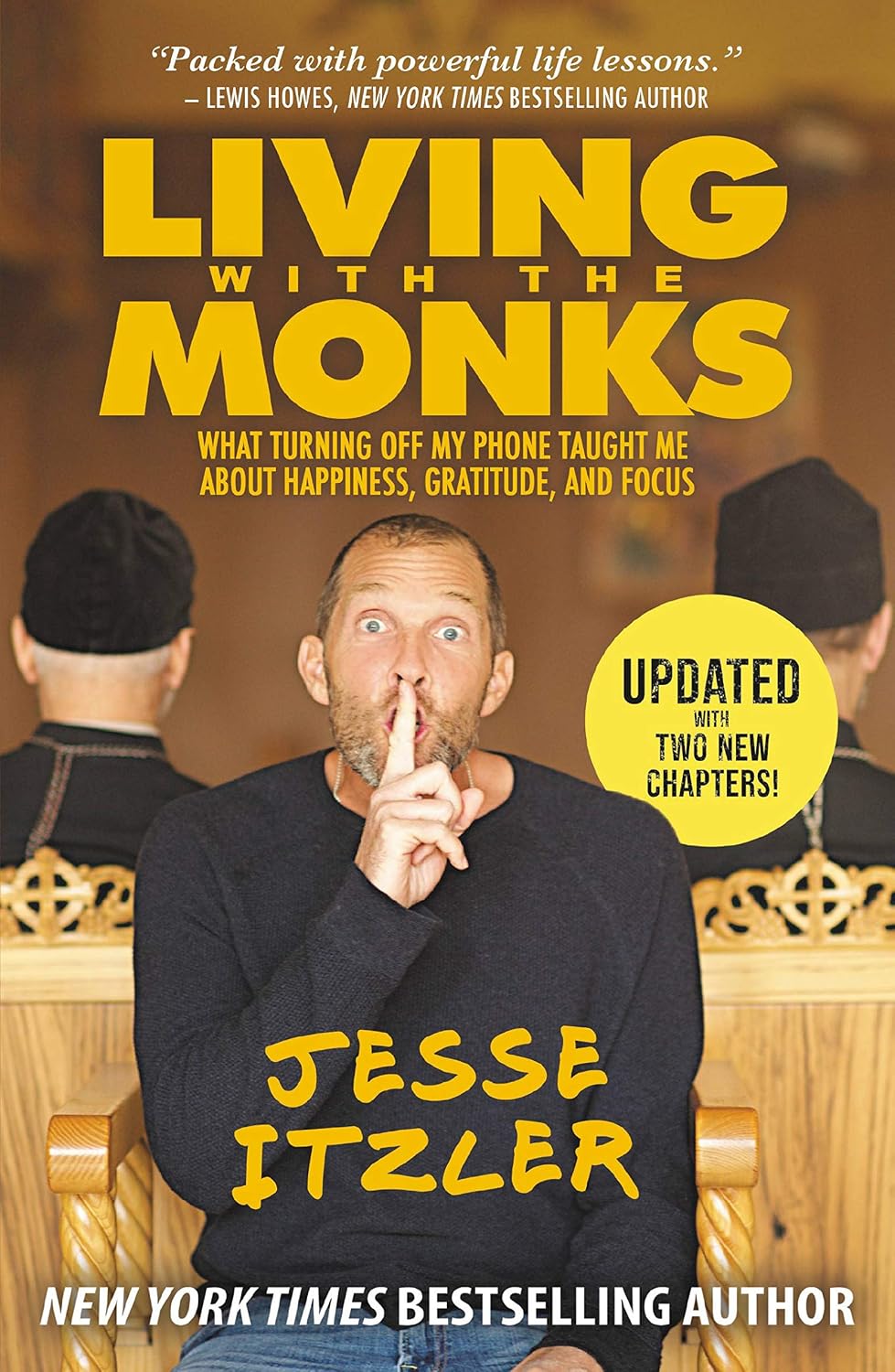
Jesse Itzler, the entrepreneur behind Marquis Jet and author of Living with a SEAL, spent fifteen days with the monks of New Skete, a monastery in upstate New York, with his phone switched off. The book is his diary of that stretch: early mornings, silence, chores, and training German shepherds alongside the brothers. What he brings home is less about religion than about attention. Do fewer things, do them fully, slow down, and notice what you already have.
Highlights
Removing yourself from the overstimulated world we live in can be difficult. So you must consider the withdrawal symptoms that may occur. Like any activity involving deep thought and introspection, some of the events in Living with the Monks may cause side effects like calmness, being present, and feeling super alive. And those side effects can become addictive, so all readers should take full responsibility when living a more vibrant life.
My wife always tells me I’m too impulsive, that I don’t think things through before taking action, and it gets me in over my head sometimes. Maybe, but I like to go with my gut.
One of my favorite business rules is: DON’T OVERSELL—when you get the order, shut up and leave.
the only way to be in tune with your gut is to be alone—thinking. I’ve found that if you lose your “gut feel” you lose one of your greatest secret weapons. In fact, in virtually all areas of life—instinct is critical.
“He will win who, prepared himself, waits to take the enemy unprepared.” —SUN TZU
A public relations mogul once told me that the key to crisis management is to get all of the bad stuff out in the open and on the table right away.
There’s a certain freedom in being totally screwed. When you’re totally screwed, things can’t get any more screwed up.
“Everyone wants to live on top of the mountain, but all the happiness and growth occurs while you’re climbing it.” —ANDY ROONEY
When I’m in my routine—time flies. When I’m not in my routine—time slows.
People often tell me time is precious. But they don’t really know. They only think it’s precious when it’s gone, or it’s slipping by. On the mountain, time felt precious because of the way you experienced it; there were moments, not minutes.
Acting now, even if the timing isn’t perfect or everything isn’t figured out, has always been the way I operate. It’s often the difference between failure and incredible accomplishment. You can’t outsmart time, but you can learn to maximize it.
“Be where you are, otherwise you will miss your life.” —BUDDHA
It’s like I always tell young entrepreneurs, “YOU ARE THE BUSINESS PLAN.”
I always tell myself I can’t get growth unless I take action.
“The greatest challenge in life is discovering who you are. The second greatest is being happy with what you find.” —UNKNOWN
There’s an old adage, “authenticity over everything,”
start the process and stay in the game. Whether it’s a business venture, big race, or a new challenge, I’ve always had a “get your foot in the door and figure the rest out later” attitude.
“It is in being alone where you find your strength. Not in others.”
“St. Paul once said there’s no difference between contentment and happiness,”
I’m down to do anything the monks ask me to do, but if I can’t get an hour or so of running in a day I’ll definitely go berserk. I’ve run virtually every day for the last twenty-five years, 9,125 straight days, over 36,000 miles. So I’m not stopping now. Plus, I’m a big believer that you have to carve some time out of each day to do the things you
It’s my own rule that I call the “three-hour rule.” You take three hours a day for yourself to do what YOU want to do. That time is cumulative. It can be going for a walk, watching TV, reading, whatever. But when you’re in that time you don’t feel guilty that you’re not with your family, at work, or doing something else. If you don’t take time for yourself—you’ll resent the people who are taking those things away from you.
“Life is really simple, but we insist on making it complicated.” —CONFUCIUS
“You know what, Jesse, I’d give it all back… the pool, the art, the apartment, EVERYTHING to have the one thing you have.” “Me? I have $128. I’m broke. What’s that?” He looked me dead in the eye as he ran. “Youth.” “Youth?” “Yes. The process, the thrill of the unknown, the long playing field ahead… it all comes with youth.
Your future is a huge canvas to paint on, and I’d trade it all to have that paintbrush back in my hand. Enjoy every minute of the process.”
Very often the process is more valuable than the outcome. As you struggle in business, with goals, at work—it’s hard to appreciate the journey. However, it is the journey that makes us feel the most alive.
We only have two kinds of memories in our life, ones that we can’t control and the ones that we create.
The memories we create of our own accord are the paintbrushes… life is the canvas.
“I want you to go past the excitement, Jesse, past the passion, past the ego, and dig into your GUT.” “Okay.” “Now tell me.… Do you believe in your heart of hearts in this sports music thing you’re doing?” “I think so. “NO, THAT’S NOT ENOUGH! Jesse, I want to know, would you bet the entire farm on this concept? I don’t want to know ‘can’ you make this work but ‘WILL’ you make this work. That means no matter what is thrown at you.”
“He who conquers others is strong; he who conquers himself is mighty.” —LAO TZU, DAO DE JING
“We all must be trained, Jesse. The power and
temptations of the outside world are great. Train yourself from the distractions. They are the enemies of your goals. Learn to move past the distractions, and you will succeed.”
“Every day is a lesson. The key is to listen.”
“When you talk, you are only repeating what you already know. But if you listen, you may learn something new.”
My wife always tells her employees, “If nobody told you how to do your job, how would you do it?” The results she gets from that are amazing. Sometimes you have to rip up the playbook, break the mold, and do it your own way.
When I get pissed off at someone who cuts me off, Sara always says, “What if that person is headed to the hospital for an emergency?” and “What if they have had a terrible day?” She’s always giving others the benefit of the doubt. It frees her from getting angry herself. “You don’t have to own it. That’s their stuff,” she likes to remind me.
“If you realize that all things change, there is nothing you will try and hold on to.”
“Treat yourself gently. Don’t talk angry to yourself. We’re all searching for peace,” she said. “But peace is already within. We simply need to work on our spirit.”
sometimes we get lost emotionally. So that makes awareness and mindfulness like the GPS. If we’re aware of how we’re feeling, it helps us process emotion to make better decisions—it gives us direction.
If we can work gut and awareness at the same time—magic can happen.
“We spend so much time worrying about things that may never happen,” he said.
He said adversity is the great activator of spiritual awakenings. Suffering is the great accelerator to going inward. In the presence of dying we discover our deepest life. Death, sickness, and loss pull us into a new moment and new way of thinking. When you deal with tragedy and it doesn’t rob you of joy and peace—it’s a great gift for others.
I always tell people that when you have a BIG goal, the work necessary to accomplish it has to become an obsession. It has to become a part of your daily lifestyle and remain that way for the duration of the goal.
1\) Have a specific date for your goal 2) Have an accountability partner 3) Put the goal in writing 4) Have a detailed plan to accomplishing your goal 5) Execute your plan
“When it is obvious that the goals cannot be reached, don’t adjust the goals, adjust the action steps.” —CONFUCIUS
When you’re alone for an extended period of time all the concerns around work, schedule, and people you’re pissed off at go away, and the important things rise to the front of your mind.
A big part of marriage is sharing in each other’s successes.
At the dinner table growing up, Sara’s father had a weekly ritual where he would ask her what she failed at that week. Maybe she had tried out for the school play, cheerleading, or a sports team. When she’d tell her dad how poorly it went, he would give her a high five. Whether she had succeeded or failed wasn’t important. All that mattered was that she tried. That ritual changed Sara’s definition of failure, and failure became tied to not trying rather than the outcome.
When she launched her product she began cold-calling buyers in department store chains and got nowhere. She eventually got a meeting at Neiman Marcus in Dallas, but her sales pitch wasn’t going so well. So Sara called an audible and asked the buyer to follow her into the bathroom. This was a first for the buyer, but she was a good sport. Sara put the footless pantyhose on in the bathroom and did her own “before and after.” The buyer said, “I get it. I’ll try them in seven stores!”
Simple manual labor helps keep your mind clear, they say.
Why do I keep looking for something I don’t have? I think it’s because I don’t want to miss out on life. I mean, we only get one shot at it, so why not try to create as many memories as possible?
For me, it’s more about happiness being a choice. I prefer to look at happiness as a lifestyle, not a goal.
But here’s the rub. As much as I love the lifestyle that includes new challenges and adventures, if I keep seeking these out to acquire more happiness, is it problematic that the lifestyle I live on a daily basis, the one that exists right in front of me, still needs more feeding? Happiness should never be insatiable.
They started a cheesecake business with $1K in savings. They went to six local restaurants in the beginning and asked them to carry their cheesecakes on a trial basis. Now, they’re world famous and bake 20,000 cakes a year! They make and sell them at their home and ship them all over the world. If you buy in person, the sales process works on the honor system. You walk in, nobody’s there. You take a cheesecake out of the fridge, put cash in an envelope, and slide it though a slot.
I always say experience is overrated. It takes too long. Start the process and figure the rest out. If you wait too long someone else will beat you to the punch or that bully in your head will talk you out of pursuing your idea.
At this stage of my life I have a very simple formula—I want low aggravation and high reward. If something has a super-high return but comes with a lot of aggravation, I’m not interested. That goes for investments, friends, travel, EVERYTHING.
If you marry your dreams with drive, urgency, passion, and a burning desire to finish what you start—you can do ANYTHING.
Expectations are tricky and often set us up for disappointment.
Around the same time, her parents were getting a divorce. She says that nearly broke her for good. But when her dad was leaving the house for the last time, he handed her a series of Wayne Dyer motivational cassettes. And this was her breakthrough. Sara started listening to the tapes every day. It helped her deal with the tragedy of her friend and the difficulty of her parents splitting up. Sara listened to the self-help tapes constantly, over and over again; she couldn’t get enough. She listened to them so much that her friends in high school started refusing to get into her car because they couldn’t take listening to them anymore. She credits Wayne Dyer CDs and the inner work she did as a big part of her success. The gap between breakthroughs and being broken is so narrow that sometimes it’s impossible to see.
Perspective is such a beautiful thing, but the key is to never let it go when you’re holding onto it.
When you come to a point when you have to make a key decision, remember how that choice will make you feel tomorrow, and the tomorrow after that, and the one after that. You want to drop out of the marathon at mile 18? Okay, that’s fine, but… remember what it’s going to feel like tomorrow when you’re left alone to
think about it. You want to get drunk and dance on the table at your holiday party? Cool, but… remember how it’s going to feel tomorrow when you walk into the office.
On my walk back to my room I came up with this: You can read The 7 Habits of Highly Effective People and listen to 115 Vince Lombardi quotes. You can study Awaken the Giant Within and go to ten Tony Robbins lectures. However, the only way to truly get better is to close the book, turn off the Internet, and go out into the world. And stick it out. When you want to quit… get uncomfortable. And Remember Tomorrow. We spend so much of our lives trying to avoid pain. We’re all wired to seek comfort and I love being comfortable. However, the real growth comes when you step outside of that comfort zone and tap into your reserve tank.
I’ve heard that grit is the best indicator of future success.
One time I asked SEAL if he ever quit something because he was tired. I don’t quit when I’m tired, he said. I quit when I’m done.
Regret can hurt just as much as physical pain and sometimes last longer.
Are there times when quitting is the right thing to do? Of course, but quitting just because it’s easier is never the right decision. It only takes a minute to quit, but the moment will replay in your mind tomorrow, and the tomorrow after that, and the one after that.
“It’s really very simple. Decide that you want it more than you’re afraid of it.”
“Every day, think as you wake up, ‘Today I am fortunate to have woken up, I am alive. I have a precious human life, I am not going to waste it. I am going to use all my energies to develop myself, to expand my heart out to others, to achieve enlightenment for the benefit of all beings. I am going to have kind thoughts towards others, I am not going to get angry or think badly about others. I am going to benefit others as much as I can.’”
It’s been said that family dinner is one of the best things you can do for a lasting marriage.
family meals when I get back. And some prayer; when the monks say grace it’s a form of gratitude. That small “thanks” every day is powerful.
I’ve learned that spiritual time doesn’t have to be carved out; I can explore the spiritual life when I’m doing mundane, trivial work.
“Every task is important. Every moment has purpose.”
For example, the brothers know they have to live with each other, so they want to live in peace. How great is that? They have allotted time every week to communicate with each other and sort out any issues. It sounds simple, but an effort needs to be made. I’m going to institute that with my wife when I get home. It’ll just mean more peace. Isn’t that great?”
“Maybe by looking for one thing you miss out on everything else.” I said. “I’ve realized that just experiencing, instead of having expectations and searching, can sometimes be better.”
People are always waiting for something to happen before they change their lives. But they have it backward; when you change your life, big things are more likely to happen.
Change costs no money at all.
The younger you make decisions to live life on your terms and do what you love to do, the more fulfilling a life you’ll live. And it’s never too late.
Nothing happens without asking for it.
As someone starting out in business, getting over the fear of being embarrassed is one of the most liberating gifts you can give yourself.
Then I asked if they had any interest in meeting anyone famous, and Brother Christopher said, “It doesn’t
matter what others are doing, it matters what you are doing.”
“When you talk, you are only repeating what you already know. But if you listen, you may learn something new.” —DALAI LAMA
It’s amazing how much better my production is when I focus solely on one task. There’s no race anymore. I finish when I finish. I finish when the job is done.
The monks have eliminated most of the self-imposed deadlines that we all put on ourselves daily. Rather, they have shifted their focus to emphasize the quality of their work. They finish when the job is thoroughly done, and then and only then are they finished.
We don’t realize that our daily decisions take up so much space in our heads, there’s no room left for creativity and more productive thought.
I broke my life into four buckets: Family, Work, Personal, and Wellness. And then I filled each category with what I want to accomplish. I saved them on my phone.
If we spend too much time worrying about things that might happen, we’ll miss out on all of the things we can improve in our lives.
Time is going fast. Load your plate up with the things you love to do.”
“Cowards never start. The weak never finish. Winners never quit.” —UNKNOWN
It’s a life-changing book, and the lessons can be applied to any life and circumstance. If your why is big enough, the how usually emerges. A big why crushes smaller obstacles every time.
In business, you ask how and how much. Rarely why. But without a strong why we’re lost, and the why often hides itself. My wife always reminds me that most advertisers talk about the “what” of a product and not the why. “This is a vacuum and it does XYZ,” but they don’t ever really talk about why you need it or why
it was created or why it’s different then everything else in the market. It’s the why that makes the customer more invested in your product and more emotionally connected.
My mother always used to say to me: “Don’t ever borrow money and don’t ever lend it. It will only cause problems. If you want to gift it, that’s fine, but remember it’s a gift.” She could not have been more right. Her one exception to the lending rule was to family.
One of the biggest takeaways from my experience is how much effort the monks put into the small things. Things like making their beds, doing the dishes, and sweeping the floors were given maximum effort. There’s an old adage: “How you do anything is how you do everything.” It’s the small things you do during the day that build your character and grit. It’s the small things you do that are indications of what you’re becoming.
That isn’t just a hose. That’s a reflection of what I am to be. By leaving the hose on the ground and telling myself it’s okay and I’ll do it later, I’m really telling myself, “Maybe someone else will do it for me” or “It’s okay to not finish what I started” or “I’ll put it off until tomorrow.” I’m basically creating an environment in my head that says it’s okay to be lazy, it’s okay to not be a finisher, it’s okay to put things off.
By consistently doing things you may not want to do, you create an environment in your head that says you’re okay doing hard things.
The average American male lives to be about seventy-eight years old, and I’m forty-nine at the writing of this book. That means if I’m average, I have about 10,495 days left. Since I sleep roughly one-third of those days I really have 7,871 days. That’s nothing, that’s only twenty-nine summers… and I LOVE SUMMERS!
We rarely think about our relationship with time, and for many of us (myself included) that relationship is often out of balance.
I started to do some math, and it put time in perspective. My parents are eighty-eight years old, and I see them about four times a year. Well, if they live to be ninety-two (I hope they live much longer), then that would mean I only have sixteen more times to see them. That’s unacceptable. When you put time in perspective, you realize what’s important and you reprioritize things. I immediately booked a flight to see them.
How many days do you have left? How do you want to spend them? And whom do you want to spend them with? As I get older these are the questions that become more and more important to me and I continue to gain an appreciation for urgency. “If you can’t live longer, live deeper.”—Italian proverb
if you’re surrounded by greatness—take notes, pay attention, and ask questions.
For starters, virtually all of them developed a process that works best for them over time. SEAL has a process. Warren Buffett has a process. The Rolling Stones have a process. And the monks definitely have a process similar to all of the other greats I’ve ever interacted with. Here’s a glimpse of theirs:
A. The monks get up early. The day started before sunrise. By the time I greeted them in church for the morning service, most of them had already tended to their dogs, meditated, and reviewed their tasks for the day. When I asked Brother Stavros why they do this, he told me the one race he ALWAYS likes to win is the race against the sun rising. Like so many of the greats in every field, mornings are magical for the monks. When I got home I started getting up around 5:00 a.m. and going for quiet jogs.
B. The monks have a plan. Every night before they went to sleep they wrote a plan for the next day. They were organized. They prioritized the important things that had to get done first and focused on completing those tasks until they went on to the next. There was no guessing as to what had to get done that day; every day had a plan, and the plan had to be executed.
The monks are efficient. There was very little dillydallying during the day. Time was sacred. I didn’t see any small talk or chatter around the monastery.
“A calm and modest life brings more happiness than the pursuit of success combined with constant restlessness.”
What I learned from the monks is that you can find calmness during your day and small doses of calmness can open a door to happiness.
We spend endless hours doing things that make us happy but invest much less time working on changing the things that make us unhappy.
Identifying what keeps you from being happier is the first step. When you begin working to remove the obstacles, you are taking the next steps to an A+.
“Do it over and over again until it becomes part of who you are.” —UNKNOWN
“Thinking: the talking of the soul with itself.” —PLATO
I really believe thinking is a lost art form.
Yet, giving ourselves time to think is one of the best investments we can make—and there’s no risk.
My wife thinks best in her car. We live two miles from her office, which is a ten-minute drive, but Sara has created a forty-minute “fake commute” so she can think (I wonder if she thought of that idea while driving in the car?). She’s set up cameras in her vehicle so she can say all of her thoughts out loud while driving and not worry about forgetting them.
That’s why I choose to run without music. I can clear my mind by listening to my footfalls.
And as soon as I finish I immediately write them down in one notebook. Putting it on paper de-clutters your head and frees up energy.
During my stay I wondered how the monks have such great ENERGY and EFFORT. They’re so EFFICIENT in EVERYTHING they do. The answer is they monotask, that’s how they do it. And they do it with perfection. The monks do their job(s) with zest, but only one dish at a time. Each dish is done like the world depends on it.
They don’t increase their effort, they increase their concentration. A task is never a race. And there’s never a finish line. There is only now.
I decided to write a “contract with myself.” A list of how I wanted to live my life. I read it to myself every morning, and it’s been helpful in guiding me during the day. This exercise takes only a second, and the benefits
Here is my contract with myself: I’m going to thank God first thing in the morning. I’m going to show appreciation for having this day. Today I’m going to be the best version of me that I can be. I’m going to try hard at whatever it is I do. I’m going to be present and patient. I’m going to be a teacher to my kids. I’m going to be a good son, brother, and friend. I’m going to be giving to my wife. I have signed many contracts in my life, but never one with myself. It feels good to write one and even better to keep it.
“Life can only be understood backwards, but it must be lived forwards.”
The monks didn’t walk around saying: “I don’t know anything about carpentry; I don’t know how to breed dogs.” What they said was, “It’s a good idea to have a monastery” and “Breeding dogs would be a good way to make money.” And then they just went about trying their best. Maybe the best part of having no experience is it’s quicker than getting experience!
For the monks, it was do or die. When the monks started their breeding business, they
read every book on dog breeding they could get their hands on, and then they read them again. They called breeders across the country and asked for help.
“The past is where you learned the lessons. The future is where you apply the lessons.”
Effort is the true source of pride—not results.
Think about it, we can’t always control the outcome, the results, but we can always control our effort.
And because of their EFFORT the monks have EDGE.
Things I Like about Monks: 1. Monks do one thing at a time. 2. Monks don’t rush. They do things slowly and deliberately. 3. Monks don’t cut corners. They do it completely. 4. Monks do less… but do more. 5. Monks remain calm. They don’t panic. 6. Monks are okay being alone—they thrive at it. 7. Monks study all different kinds of topics
to enhance growth. 8. Monks devote time to sitting. 9. Monks smile. 10. Monks live simply. 11. Monks don’t waste time. 12. Monks have a strong community and family unit. 13. Monks have a love affair with life.
I realized that if I take just one hour of personal time a day for the next thirty years, I’ll gain about 11,000 hours of “me” time.
I haven’t changed. I’ve expanded. I now have a collection of memories in my brain’s photo album that I can access at any time.
Part of my “why” as it relates to the monastery was to add to my life résumé. It’s another experience, another adventure, another thing I can look back on and be proud of as I get older. I’m a believer in having a bucket list. Bucket lists are great!
The fuck-it list is a collection of things you always wanted to do, but maybe were too scared, felt the timing wasn’t right, or maybe you believed you didn’t have enough experience.