- Rating
- —/10
- Read
- August 2026
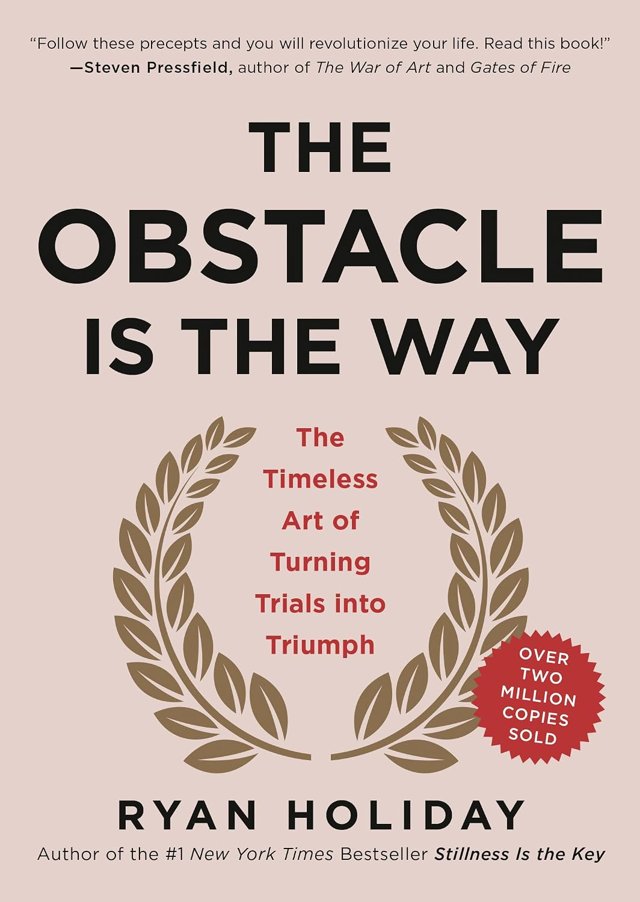
The whole book grows out of a line from Marcus Aurelius: “The impediment to action advances action. What stands in the way becomes the way.” Holiday argues that every obstacle carries the means of beating it, and he splits the work into three disciplines: how you see the problem, what you do about it, and how you hold up when it doesn’t move.
Highlights
The impediment to action advances action. What stands in the way becomes the way.
what impedes us can empower us.
He truly saw each and every one of these obstacles as an opportunity to practice some virtue: patience, courage, humility, resourcefulness, reason, justice, and creativity.
Whatever we face, we have a choice: Will we be blocked by obstacles, or will we advance through and over them?
Every obstacle is unique to each of us. But the responses they elicit are the same: Fear. Frustration. Confusion. Helplessness. Depression. Anger.
We blame our bosses, the economy, our politicians, other people, or we write ourselves off as failures or our goals as impossible. When really only one thing is at fault: our attitude and approach.
Andy Grove, former CEO of Intel, outlined when he described what happens to businesses in tumultuous times: “Bad companies are destroyed by crisis. Good companies survive them. Great companies are improved by them.”
Great individuals, like great companies, find a way to transform weakness into strength. It’s a rather amazing and even touching feat. They took what should have held them back—what in fact might be holding you back right this very second—and used it to move forward.
They had the ability to see obstacles for what they were, the ingenuity to tackle them, and the will to endure a world mostly beyond their comprehension and control.
There is an old Zen story about a king whose people had grown soft and entitled. Dissatisfied with this state of affairs, he hoped to teach them a lesson. His plan was simple: He would place a large boulder in the middle of the main road, completely blocking entry into the city. He would then hide nearby and observe their reactions. How would they respond? Would they band together to remove it? Or would they get discouraged, quit, and return home? With growing disappointment, the king watched as subject after subject came to this impediment and turned away. Or, at best, tried halfheartedly before giving up. Many openly complained or cursed the king or fortune or bemoaned the inconvenience, but none managed to do anything about it.
After several days, a lone peasant came along on his way into town. He did not turn away. Instead he strained and strained, trying to push it out of the way. Then an idea came to him: He scrambled into the nearby woods to find something he could use for leverage. Finally, he returned with a large branch he had crafted into a lever and deployed it to dislodge the massive rock from the road. Beneath the rock were a purse of gold coins and a note from the king, which said: “The obstacle in the path becomes the path. Never forget, within every obstacle is an opportunity to improve our condition.”
Overcoming obstacles is a discipline of three critical steps. It begins with how we look at our specific problems, our attitude or approach; then the energy and creativity with which we actively break them down and turn them into opportunities; finally, the cultivation and maintenance of an inner will that allows us to handle defeat and difficulty. It’s three interdependent, interconnected, and fluidly contingent disciplines: Perception, Action, and the Will.
WHAT IS PERCEPTION? It’s how we see and understand what occurs around us—and what we decide those events will mean. Our perceptions can be a source of strength or of great weakness. If we are emotional, subjective and shortsighted, we only add to our troubles. To prevent becoming overwhelmed by the world around us, we must, as the ancients practiced, learn how to limit our passions and their control over our lives. It takes skill and discipline to bat away the pests of bad perceptions, to separate reliable signals from deceptive ones, to filter out prejudice, expectation, and fear. But it’s worth it, for what’s left is truth. While others are excited or afraid, we will remain calm and imperturbable. We will see things simply and straightforwardly, as they truly are—neither good nor bad. This will be an incredible advantage for us in the fight against obstacles.
the young Rockefeller took his first job in 1855 at the age of sixteen (a day he celebrated as “Job Day” for the rest of his life).
“Oh, how blessed young men are who have to struggle for a foundation and beginning in life,” he once said. “I shall never cease to be grateful for the three and half years of apprenticeship and the difficulties to be overcome, all along the way.” Of course, many people experienced the same perilous times as Rockefeller—they all attended the same school of bad times. But few reacted as he did. Not many had trained themselves to see opportunity inside this obstacle, that what befell them was not unsalvageable misfortune but the gift of education—a chance to learn from a rare moment in economic history.
You will come across obstacles in life—fair and unfair. And you will discover, time and time again, that what matters most is not what these obstacles are but how we see them, how we react to them, and whether we keep our composure. You will learn that this reaction determines how successful we will be in overcoming—or possibly thriving because of—them.
To perceive what others see as negative, as something to be approached rationally, clearly, and, most important, as an opportunity—not as something to fear or bemoan.
We can learn to perceive things differently, to cut through the illusions that others believe or fear. We can stop seeing the “problems” in front of us as problems. We can learn to focus on what things really are. Too often we react emotionally, get despondent, and lose our perspective. All that does is turn bad things into really bad things. Unhelpful perceptions can invade our minds—that sacred place of reason, action and will—and throw off our compass.
We have a choice about how we respond to this situation (or any situation, for that matter). We can be blindly led by these primal feelings or we can understand them and learn to filter them. Discipline in perception lets you clearly see the advantage and the proper course of action in every situation—without the pestilence of panic or fear. Rockefeller understood this well and threw off the fetters of bad, destructive perceptions. He honed the ability to control and channel and understand these signals. It was like a superpower; because most people can’t access this part of themselves, they are slaves to impulses and instincts they have never questioned. We can see disaster rationally. Or rather, like Rockefeller, we can see opportunity in every disaster, and transform that negative situation into an education, a skill set, or a fortune. Seen properly, everything that happens—be it an economic crash or a personal tragedy—is a chance to move forward. Even if it is on a bearing that we did not anticipate. There are a few things to keep in mind when faced with a seemingly insurmountable obstacle. We must try: To be objective To control emotions and keep an even keel To choose to see the good in a situation To steady our nerves To ignore what disturbs or limits others To place things in perspective To revert to the present moment To focus on what can be controlled This is how you see the opportunity within the obstacle. It does not happen on its own. It is a process—one that results from self-discipline and logic. And that logic is available to you. You just need to deploy it. RECOGNIZE YOUR POWER
Choose not to be harmed—and you won’t feel harmed. Don’t feel harmed—and you haven’t been. —MARCUS AURELIUS
We decide what we will make of each and every situation. We decide whether we’ll break or whether we’ll resist. We decide whether we’ll assent or reject. No one can force us to give up or to believe something that is untrue (such as, that a situation is absolutely hopeless or impossible to improve). Our perceptions are the thing that we’re in complete control of.
if we have our wits fully about us, we can step back and remember that situations, by themselves, cannot be good or bad. This is something—a judgment—that we, as human beings, bring to them with our perceptions. To one person a situation may be negative. To another, that same situation may be positive. “Nothing either good or bad, but thinking makes it so,” as Shakespeare put it.
There is no good or bad without us, there is only perception. There is the event itself and the story we tell ourselves about what it means.
An employee in your company makes a careless mistake that costs you business. This can be exactly what you spend so much time and effort trying to avoid. Or, with a shift in perception, it can be exactly what you were looking for—the chance to pierce through defenses and teach a lesson that can be learned only by experience. A mistake becomes training.
Just because your mind tells you that something is awful or evil or unplanned or otherwise negative doesn’t mean you have to agree.
What such a man needs is not courage but nerve control, cool headedness. This he can get only by practice. —THEODORE ROOSEVELT
Don’t forget, there are always people out there looking to get you. They want to intimidate you. Rattle you. Pressure you into making a decision before you’ve gotten all the facts. They want you thinking and acting on their terms, not yours. So the question is, are you going to let them?
When America raced to send the first men into space, they trained the astronauts in one skill more than in any other: the art of not panicking. When people panic, they make mistakes. They override systems. They disregard procedures, ignore rules. They deviate from the plan. They become unresponsive and stop thinking clearly. They just react—not to what they need to react to, but to the survival hormones that are coursing through their veins.
The Greeks had a word for this: apatheia. It’s the kind of calm equanimity that comes with the absence of irrational or extreme emotions. Not the loss of feeling altogether, just the loss of the harmful, unhelpful kind. Don’t let the negativity in, don’t let those emotions even get started. Just say: No, thank you. I can’t afford to panic.
focus your energy exclusively on solving problems, rather than reacting to them.
“When you worry, ask yourself, ‘What am I choosing to not see right now?’ What important things are you missing because you chose worry over introspection, alertness or wisdom?”
Another way of putting it: Does getting upset provide you with more options? Sometimes it does. But in this instance? No, I suppose not
Marcus’s question: Does what happened keep you from acting with justice, generosity, self-control, sanity, prudence, honesty, humility, straightforwardness?
In The Book of Five Rings, he notes the difference between observing and perceiving. The perceiving eye is weak, he wrote; the observing eye is strong. Musashi understood that the observing eye sees simply what is there. The perceiving eye sees more than what is there. The observing eye sees events, clear of distractions, exaggerations, and misperceptions. The perceiving eye sees “insurmountable obstacles” or “major setbacks” or even just “issues.” It brings its own issues to the fight. The former is helpful, the latter is not.
This is why Musashi and most martial arts practitioners focus on mental training as much as on physical training. Both are equally important—and require equally vigorous exercise and practice.
Epictetus told his students, when they’d quote some great thinker, to picture themselves observing the person having sex. It’s funny, you should try it the next time someone intimidates you or makes you feel insecure. See them in your mind, grunting, groaning, and awkward in their private life—just like the rest of us. Marcus Aurelius had a version of this exercise where he’d describe glamorous or expensive things without their euphemisms—roasted meat is a dead animal and vintage wine is old, fermented grapes. The aim was to see these things as they really are, without any of the ornamentation. We can do this for anyone or to anything that stands in our way. That promotion that means so much, what is it really? Our critics and naysayers who make us feel small, let’s put them in their proper place. It’s so much better to see things as they truly, actually are, not as we’ve made them in our minds. Objectivity means removing “you”—the subjective part—from the equation. Just think, what happens when we give others advice? Their problems are crystal clear to us, the solutions obvious. Something that’s present when we deal with our own obstacles is always missing when we hear other people’s problems: the baggage. With other people we can be objective. We take the situation at face value and immediately set about helping our friend to solve it. Selfishly—and stupidly—we save the pity and the sense of persecution and the complaints for our own lives. Take your situation and pretend it is not happening to you. Pretend it is…
euphemisms—roasted meat is a dead animal and vintage wine is old, fermented grapes. The aim was to see these things as they really are, without any of the ornamentation.
Objectivity means removing “you”—the subjective part—from the equation. Just think, what happens when we give others advice? Their problems are crystal clear to us, the solutions obvious. Something that’s present when we deal with our own obstacles is always missing when we hear other people’s problems: the baggage. With other people we can be objective.
Take your situation and pretend it is not happening to you. Pretend it is not important, that it doesn’t matter. How much easier would it be for you to know what to do? How much more quickly and dispassionately could you size up the scenario and its options? You could write it off, greet it calmly. Think of all the ways that someone could solve a specific problem. No, really think. Give yourself clarity, not sympathy—there’ll be plenty of time for that later. It’s an exercise, which means it takes repetition. The more you try it, the better…
Man does not simply exist but always decides what his existence will be, what he will become the next moment. By the same token, every human being has the…
Perspective is everything. That is, when you can break apart something, or look at it from some new angle, it loses its power over you.
The task, as Pericles showed, is not to ignore fear but to explain it away.
We can’t change the obstacles themselves—that part of the equation is set—but the power of perspective can change how the obstacles appear.
George Clooney spent his first years in Hollywood getting rejected at auditions. He wanted the producers and directors to
like him, but they didn’t and it hurt and he blamed the system for not seeing how good he was. This perspective should sound familiar. It’s the dominant viewpoint for the rest of us on job interviews, when we pitch clients, or try to connect with an attractive stranger in a coffee shop. We subconsciously submit to what Seth Godin, author and entrepreneur, refers to as the “tyranny of being picked.” Everything changed for Clooney when he tried a new perspective. He realized that casting is an obstacle for producers, too—they need to find somebody, and they’re all hoping that the next person to walk in the room is the right somebody. Auditions were a chance to solve their problem, not his. From Clooney’s new perspective, he was that solution. He wasn’t going to be someone groveling for a shot. He was someone with something special to offer. He was the answer to their prayers, not
the other way around. That was what he began projecting in his auditions—not exclusively his acting skills but that he was the man for the job. That he understood what the casting director and producers were looking for in a specific role and that he would deliver it in each and every situation, in preproduction, on camera, and during promotion.
In life our first job is this, to divide and distinguish things into two categories: externals I cannot control, but the choices I make with regard to them I do control. Where will I find good and bad? In me, in my choices. —EPICTETUS
Behind the Serenity Prayer is a two-thousand-year-old Stoic phrase: “ta eph’hemin, ta ouk eph’hemin.” What is up to us, what is not up to us. And what is up to us? Our emotions Our judgments Our creativity
Our attitude Our perspective Our desires Our decisions Our determination
Focusing exclusively on what is in our power magnifies and enhances our power. But every ounce of energy directed at things we can’t actually influence is wasted—self-indulgent and self-destructive. So
To see an obstacle as a challenge, to make the best of it anyway, that is also a choice—a choice that is up to us. Will I have a chance, Coach? Ta eph’hemin? Is this up to me?
Do yourself a favor and run down the list of businesses started during depressions or economic crises.
For all species other than us humans, things just are what they are. Our problem is that we’re always trying to figure out what things mean—why things are the way they are. As though the why matters. Emerson put it best: “We cannot spend the day in explanation.” Don’t waste time on false constructs.
THINK DIFFERENTLY
Genius is the ability to put into effect what is in your mind. There’s no other definition of it. —F. SCOTT FITZGERALD
Steve Jobs was famous for what observers called his “reality distortion field.” Part motivational tactic, part sheer drive and ambition, this field made him notoriously dismissive of phrases such as “It can’t be done” or “We need more time.” Having learned early in life that reality was falsely hemmed in by rules and compromises that people had been taught as children, Jobs had a much more aggressive idea of what was or wasn’t possible. To him, when you factored in vision and work ethic, much of life was malleable.
work ethic, much of life was malleable.
For instance, in the design stages for a new mouse for an early Apple product, Jobs had high expectations. He wanted it to move fluidly in any direction—a new development for any mouse at that time—but a lead engineer was told by one of his designers that this would be commercially impossible. What Jobs wanted wasn’t realistic and wouldn’t work. The next day, the lead engineer arrived at work to find that Steve Jobs had fired the employee who’d said that. When the replacement came in, his first words were: “I can build the mouse.”
Our perceptions determine, to an incredibly large degree, what we are and are not capable of. In many ways, they determine reality itself. When we believe in the obstacle more than in the goal, which will inevitably triumph?
This is why we shouldn’t listen too closely to what other people say (or to what the voice in our head says, either). We’ll find ourselves erring on the side of accomplishing nothing. Be open. Question. Though of course we don’t control reality, our perceptions do influence it.
One week before the first Macintosh computer was supposed to ship, the engineers told Jobs they couldn’t make the deadline. On a hastily assembled conference call, the engineers explained that they needed just two additional weeks’ work before it was ready. Jobs responded calmly, explaining to the engineers that if they could make it in two weeks, they could surely make it one—there was no real difference in such a short period of time. And, more important, since they’d come this far and done so much good work, there was no way they would not ship on January 16, the original ship date.
Now, how do you and I usually deal with an impossible deadline handed down from someone above us? We complain. We get angry. We question. How could they? What’s the point? Who do they think I am? We look for a way out and feel sorry for ourselves. Of course, none of these things affect the objective reality of that deadline. Not in the way that pushing forward can. Jobs refused to tolerate people who didn’t believe in their own abilities to succeed. Even if his demands were unfair, uncomfortable, or ambitious.
Jobs learned to reject the first judgments and the objections that spring out of them because those objections are almost always rooted in fear. When he ordered a special kind of glass for the first iPhone, the manufacturer was aghast at the aggressive deadline. “We don’t have capacity,” they said. “Don’t be afraid,” Jobs replied. “You can do it. Get your mind around it. You can do it.” Nearly overnight, manufacturers transformed their facilities into glass-making behemoths, and within six months they’d made enough for the whole first run of the phone.
An entrepreneur is someone with faith in their ability to make something where there was nothing before. To them, the idea that no one has ever done this or that is a good thing. When given an unfair task, some rightly see it as a chance to test what they’re made of—to give it all they’ve got, knowing full well how difficult it will be to win. They see it as an opportunity because it is often in that desperate nothing-to-lose state that we are our most creative. Our best ideas come from there, where obstacles illuminate new options.
A good person dyes events with his own color . . . and turns whatever happens to his own benefit. —SENECA
It’s one thing to not be overwhelmed by obstacles, or discouraged or upset by them. This is something that few are able to do. But after you have controlled your emotions, and you can see objectively and stand steadily, the next step becomes possible: a mental flip, so you’re looking not at the obstacle but at the opportunity within it.
“There is good in everything, if only we look for it.” Yet we are so bad at looking. We close our eyes to the gift.
Or that computer glitch that erased all your work? You will now be twice as good at it since you will do it again. How about that business decision that turned out to be a mistake? Well, you had a hypothesis and it turned out to be wrong. Why should that upset you? It wouldn’t piss off a scientist, it would help him. Maybe don’t bet so much on it
next time. And now you’ve learned two things: that your instinct was wrong, and the kind of appetite for risk you really have.
The obstacle is an advantage, not adversity. The enemy is any perception that prevents us from seeing this.
Everything can be flipped, seen with this kind of gaze: a piercing look that ignores the package and sees only the gift.
Problems are rarely as bad as we think—or rather, they are precisely as bad as we think.
It’s a huge step forward to realize that the worst thing to happen is never the event, but the event and losing your head.
We forget: In life, it doesn’t matter what happens to you or where you came from. It matters what you do with what happens and what you’ve been given.
People turn shit into sugar all the time—shit that’s a lot worse than whatever we’re dealing with. I’m talking physical disabilities, racial discrimination, battles against overwhelmingly superior armies. But those people didn’t quit. They didn’t feel sorry for themselves. They didn’t delude themselves with fantasies about easy solutions. They focused on the one thing that mattered: applying
themselves with gusto and creativity.
Therefore, we can always (and only) greet our obstacles with energy
with persistence with a coherent and deliberate process with iteration and resilience with pragmatism with strategic vision with craftiness and savvy and an eye for opportunity and pivotal moments
Because that’s what people who defy the odds do. That’s how people who
become great at things—whether it’s flying or blowing through gender stereotypes—do. They start. Anywhere. Anyhow. They don’t care if the conditions are perfect or if they’re being slighted. Because they know that once they get started, if they can just get some momentum, they can make it work.
Now let’s say you’ve already done that. Fantastic. You’re already ahead of most people. But let’s ask an honest question: Could you be doing more?
So when you’re frustrated in pursuit of your own goals, don’t sit there and complain that you don’t have what you want or that this obstacle won’t budge. If you haven’t even tried yet, then of course you will still be in the exact same place. You haven’t actually pursued anything.
If you want momentum, you’ll have to create it yourself, right now, by getting up and getting started.
He says the best way out is always through And I agree to that, or in so far As I can see no way out but through. —ROBERT FROST
We will not be stopped by failure, we will not be rushed or distracted by external noise. We will chisel and peg away at the obstacle until it is gone. Resistance is futile.
In 1878, Thomas Edison wasn’t the only person experimenting with incandescent lights. But he was the only man willing to test six thousand different filaments—including one made from the beard hair of one of his men—inching closer each time to the one that would finally work.
And, of course, he eventually found it—proving that genius often really is just persistence in disguise.
Too many people think that great victories like Grant’s and Edison’s came from a flash of insight. That they cracked the problem with pure genius. In fact, it was the slow pressure, repeated from many different angles, the elimination of so many other more promising options, that slowly and surely churned the solution to the top of the pile. Their genius was unity of purpose, deafness to doubt, and the desire to stay at it.
For most of what we attempt in life, chops are not the issue. We’re usually skilled and knowledgeable and capable enough. But do we have the patience to refine our idea? The energy to beat on enough doors until we find investors or supporters? The persistence to slog through the politics and drama of working with a group? Once you start attacking an obstacle, quitting is not an option. It cannot enter your head. Abandoning one path for another that might be more promising? Sure, but that’s a far cry from giving up. Once you can envision yourself quitting altogether, you might as well ring the bell. It’s done. Consider this mind-set. never in a hurry never worried never desperate never stopping short Remember and remind yourself of a phrase favored
by Epictetus: “persist and resist.” Persist in your efforts. Resist giving in to distraction, discouragement, or disorder. There’s no need to sweat this or feel rushed. No need to get upset or despair. You’re not going anywhere—you’re not going to be counted out. You’re in this for the long haul.
Doing new things invariably means obstacles. A new path is, by definition, uncleared. Only with persistence and time can we cut away debris and remove impediments.
It’s supposed to be hard. Your first attempts aren’t going to work. It’s going to take a lot out of you—but energy is an asset we can always find more of. It’s a renewable resource. Stop looking for an epiphany, and start looking for weak points. Stop looking for angels, and start looking for angles.
What is defeat? Nothing but education; nothing but the first steps to something better. —WENDELL PHILLIPS
When failure does come, ask: What went wrong here? What can be improved? What am I missing? This helps birth alternative ways of doing what needs to be done, ways that are often much better than what we started with. Failure puts you in corners you have to think your way out of. It is a source of breakthroughs. This is why stories of great success are often preceded by epic failure—because the people in them went back to the drawing board.
The one way to guarantee we don’t benefit from failure—to ensure it is a bad thing—is to not learn from it. To continue to try the same thing over and over (which is the definition of insanity for a reason). People fail in small ways all the time. But they don’t learn. They don’t listen. They don’t see the problems that failure exposes. It doesn’t make them better.
It’s time you understand that the world is telling you something with each and every failure and action. It’s feedback—giving you precise instructions on how to improve, it’s trying to wake you up from your cluelessness. It’s trying to teach you something. Listen. Lessons come hard only if you’re deaf to them. Don’t be.
Failure shows us the way—by showing us what isn’t the way.
Under the comb the tangle and the straight path are the same. —HERACLITUS
Coach Nick Saban doesn’t actually refer to it very often, but every one of his assistants and players lives by it. They say it for him, tattooing it at the front of their minds and on every action they take, because just two words are responsible for their unprecedented success: The Process. Saban, the head coach of the University of Alabama football team—perhaps the most dominant dynasty in the history of college football—doesn’t focus on what every other coach focuses on, or at least not the way they do. He teaches The Process.
“Don’t think about winning the SEC Championship. Don’t think about the national championship. Think about what you needed to do in this drill, on this play, in this moment. That’s the process: Let’s think about what we can do today, the task at hand.”
In the chaos of sport, as in life, process provides us a way. It says: Okay, you’ve got to do something very difficult. Don’t focus on that. Instead break it down into pieces. Simply do what you need to do right now. And do it well. And then move on to the next thing. Follow the process and not the prize.
The process is about finishing. Finishing games. Finishing workouts. Finishing film sessions. Finishing drives. Finishing reps. Finishing plays. Finishing blocks. Finishing the smallest task you have right in front of you and finishing it well.
We are A-to-Z thinkers, fretting about A, obsessing over Z, yet forgetting all about B through Y.
Sometimes, on the road to where we are going or where we want to be, we have to do things that we’d rather not do. Often when we are just starting out, our first jobs “introduce us to the broom,” as Andrew Carnegie famously put it. There’s nothing shameful about sweeping. It’s just another opportunity to excel—and to learn. But you, you’re so busy thinking about the future, you don’t take any pride in the tasks you’re given right now.
Everything we do matters—whether it’s making smoothies while you save up money or studying for the bar—even after you already achieved the success you sought. Everything is a chance to do and be your best. Only self-absorbed assholes think they are too good for whatever their current station requires.
The cucumber is bitter? Then throw it out. There are brambles in the path? Then go around. That’s all you need to know. —MARCUS AURELIUS
n 1915, deep in the jungles of South America, the rising conflict between two rival American fruit companies came to a head. Each desperately wanted to acquire the same five thousand acres of valuable land. The issue? Two different locals claimed to own the deed to the plantation. In the no-man’s-land between Honduras and Guatemala, neither company was able to tell who was the rightful owner so they could buy it from them. How they each responded to this problem was defined by their company’s organization and ethos. One company was big and powerful, the other crafty and cunning. The first, one of the most powerful corporations in the United States: United Fruit. The second, a
small upstart owned by Samuel Zemurray. To solve the problem, United Fruit dispatched a team of high-powered lawyers. They set out in search of every file and scrap of paper in the country, ready to pay whatever it cost to win. Money, time, and resources were no object. Zemurray, the tiny, uneducated competitor, was outmatched, right? He couldn’t play their game. So he didn’t. Flexible, fluid, and defiant, he just met separately with both of the supposed owners and bought the land from each of them. He paid twice, sure, but it was over. The land was his. Forget the rule book, settle the issue.
Zemurray always treated obstacles this way. Told he couldn’t build a bridge he needed across the Utila River—because government officials had been bribed by competitors to make bridges illegal—Zemurray had his engineers build two long piers instead. And in between which reached out far into the center of the river, they strung a temporary pontoon that could be assembled and deployed to connect them in a matter of hours.
Never attack where it is obvious, Washington told his men. Don’t attack as the enemy would expect, he explained, instead, “Where little danger is apprehended, the more the enemy will be unprepared and consequently there is the fairest prospect of success.”
If we’re starting from scratch and the established players have had time to build up their defenses, there is just no way we are going to beat them on their strengths. So it’s smarter to not even try, but instead focus our limited resources elsewhere. Part of the reason why a certain skill often seems so effortless for great masters is not just because they’ve mastered the process—they really are doing less than the rest of us who don’t know any better. They choose to exert only calculated force where it will be effective, rather than straining and struggling with pointless attrition tactics.
You don’t convince people by challenging their longest and most firmly held opinions. You find common ground and work from there. Or you look for leverage to make them listen. Or you create an alternative with so much support from other people that the opposition voluntarily abandons its views and joins your camp.
Remember, sometimes the longest way around is the shortest way home.
Gandhi didn’t fight for independence for India. The British Empire did all of the fighting—and, as it happens, all of the losing. That was deliberate, of course. Gandhi’s extensive satyagraha campaign and civil disobedience show that action has many definitions. It’s not always moving forward or even obliquely. It can also be a matter of positions. It can be a matter of taking a stand. Sometimes you overcome obstacles not by attacking them but by withdrawing and letting them attack you. You can use the actions of others against themselves instead of acting yourself.
Martin Luther King Jr., taking Gandhi’s lead, told his followers that they would meet “physical force with soul force.” In other words, they would use the power of opposites. In the face of violence they would be peaceful, to hate they would answer with love—and in the process, they would expose those attributes as indefensible and evil.
Perhaps your enemy or obstacle really is
insurmountable—as it was for many of these groups. Perhaps in this case, you haven’t got the ability to win through attrition (persistence) or you don’t want to risk learning on the job (iterate). Okay. You’re still a long way from needing to give up. It is, however, time to acknowledge that some adversity might be impossible for you to defeat—no matter how hard you try. Instead, you must find some way to use the adversity, its energy, to help yourself. Before the invention of steam power, boat captains had an ingenious way of defeating the wickedly strong current of the Mississippi River. A boat going upriver would pull alongside a boat about to head downriver, and after wrapping a rope around a tree or a rock, the boats would tie themselves to each other. The second boat would let go and let the river take it downstream, slingshotting the other vessel upstream. So instead of fighting obstacles, find a means of making them defeat themselves.
We all have our own constraints to deal with—rules and social norms we’re required to observe that we’d rather not. Dress codes, protocols, procedures, legal obligations, and company hierarchies that are all telling us how we have to behave. Think about it too much and it can start to feel oppressive, even suffocating. If we’re not careful, this is likely to throw us off our game. Instead of giving in to frustration, we can put it to good use. It can power our actions, which, unlike our disposition, become stronger and better when loose and bold. While others obsess with observing the rules, we’re subtly undermining them and subverting them to our advantage.
“You never want a serious crisis to go to waste. Things that we had postponed for too long, that were long-term, are now immediate and must be dealt with. [A] crisis provides the opportunity for us to do things that you could not do before.”
Ordinary people shy away from negative situations, just as they do with failure. They do their best to avoid trouble. What great people do is the opposite. They are their best in these situations. They turn personal tragedy or misfortune—really anything, everything—to their advantage. But this crisis in front of you? You’re wasting it feeling sorry for yourself, feeling tired or disappointed. You forget: Life speeds on the bold and favors the brave.
At certain moments in our brief existences we are faced with great trials. Often those trials are frustrating, unfortunate, or unfair. They seem to come exactly when we think we need them the least. The question is: Do we accept this as an exclusively negative event, or can we get past whatever negativity or adversity it represents and mount an offensive? Or more precisely, can we see that this “problem” presents an opportunity for a solution that we have long been waiting for?
Perceptions can be managed. Actions can be directed. We can always think clearly, respond creatively. Look for opportunity, seize the initiative. What we can’t do is control the world around us—not as much as we’d like to, anyway. We might perceive things well, then act rightly, and fail anyway. Run it through your head like this: Nothing can ever prevent us from trying. Ever.
By age twelve, Theodore Roosevelt had spent almost every day of his short life struggling with horrible asthma. Despite his privileged birth, his life hung in a precarious balance—the attacks were an almost nightly near-death experience. Tall, gangly, and frail, the slightest exertion would upset the entire balance and leave him bedridden for weeks. One day his father came into his room and delivered a message that would change the young boy’s life: “Theodore, you have the mind but haven’t got the body. I’m giving you the tools to make your body. It’s going to be hard drudgery and I think you have the determination to go through with it.” You’d think that would be lost on a child, especially a fragile one born into great wealth and status. But according to Roosevelt’s younger sister, who witnessed the conversation, it wasn’t. His response, using what would become his trademark cheerful grit, was to look at his father and say with determination: “I’ll make my body.” At the gym that his father built on the second-floor porch, young Roosevelt proceeded to work out feverishly every day for the next five years, slowly building muscle and strengthening his upper body against his weak lungs and for the future. By his early twenties the battle against asthma was essentially over, he’d worked—almost literally—that weakness out of his body.
We take weakness for granted. We assume that the way we’re born is the way we simply are, that our disadvantages are permanent. And then we atrophy from there.
A writer like Seneca would begin by reviewing or rehearsing his plans, say, to take a trip. And then he would go over, in his head (or in writing), the things that could go wrong or prevent it from happening: a storm could arise, the captain could fall ill, the ship could be attacked by pirates. “Nothing happens to the wise man against his expectation,” he wrote to a friend. “. . . nor do all things turn out for him as he wished but as he reckoned—and above all he reckoned that something could block his plans.”
Beware the calm before the storm. Hope for the best, prepare for the worst.
Thomas Jefferson: born quiet, contemplative, and reserved—purportedly with a speech impediment. Compared to the great orators of his time—Patrick Henry, John Wesley, Edmund Burke—he was a terrible public speaker. His heart set on politics, he had two options: Fight against this sentence, or accept it. He chose the latter, channeling the energy into his writing, which others put into oratory instead. There he found his medium. He found he could express himself clearly. Writing was his strength. Jefferson was the one the founding fathers turned to when they needed the Declaration of Independence. He wrote one of the most important documents in history, in a single draft.
Same goes for Edison, who, as most people have no idea, was almost completely deaf. Or Helen Keller, who was deaf and blind. For both, it was the deprivation of these senses—and acceptance rather than resentment of that fact—that allowed them to develop different, but acutely powerful, senses to adjust to their reality. It doesn’t always feel that way but constraints in life are a good thing. Especially if we can accept them and let them direct us. They push us to places and to develop skills that we’d otherwise never have pursued.
(and the not so ancients) used the word fate far more frequently than us because they were better acquainted with and exposed to how capricious and random the world could be. Events were considered to be the “will of the Gods.” The Fates were forces that shaped our lives and destinies, often not with much consent. Letters used to be signed “Deo volente”—God willing. Because who knew what would happen? Think of George Washington, putting everything he had into the American Revolution, and then saying, “The event is in the hand of God.” Or Eisenhower, writing to his wife on the eve of the Allied invasion at Sicily: “Everything we could think of have been done, the troops are fit everybody is doing his best. The answer is in the lap of the gods.” These were not guys prone to settling or leaving the details up to other people—but they understood ultimately that what happened would happen. And they’d go from there. It’s time to be humble and flexible enough to acknowledge the same in our own lives. That there is always someone or something that could change the plan. And that person is not us. As the saying goes, “Man proposes but God disposes. ”
At age sixty-seven, Thomas Edison returned home early one evening from another day at the laboratory. Shortly after dinner, a man came rushing into his house with urgent news: A fire had broken out at Edison’s research and production campus a few miles away. Fire engines from eight nearby towns rushed to the scene, but they could not contain the blaze. Fueled by the strange chemicals in the various buildings, green and yellow flames shot up six and seven stories, threatening to destroy the entire empire Edison had spent his
life building. Edison calmly but quickly made his way to the fire, through the now hundreds of onlookers and devastated employees, looking for his son. “Go get your mother and all her friends,” he told his son with childlike excitement. “They’ll never see a fire like this again.” What?! Don’t worry, Edison calmed him. “It’s all right. We’ve just got rid of a lot of rubbish.” That’s a pretty amazing reaction. But when you think about it, there really was no other response. What should Edison have done? Wept? Gotten angry? Quit and gone home? What, exactly, would that have accomplished? You know the answer now: nothing. So he didn’t waste time indulging himself. To do great things, we need to be able to endure tragedy and setbacks. We’ve got to love what we do and all that it entails, good and bad. We have to learn to find joy in every single thing that happens.
Still, Edison wasn’t heartbroken, not as he could have and probably should have been. Instead, it invigorated him. As he told a reporter the next day, he wasn’t too old to make a fresh start. “I’ve been through a lot of things like this. It prevents a man from being afflicted with ennui.” Within about three weeks, the factory was partially back up and running. Within a month, its men were working two shifts a day churning out new products the world had never seen. Despite a loss of almost $1 million dollars (more than $23 million in today’s dollars), Edison would marshal enough energy to make nearly 10milliondollarsinrevenuethatyear(200-plus million today). He not only suffered a spectacular disaster, but he recovered and replied to it spectacularly.
We don’t get to choose what happens to us, but we can always choose how we feel about it.
And why on earth would you choose to feel anything but good?
Persistence is an action. Perseverance is a matter of will. One is energy. The other, endurance
Death doesn’t make life pointless, but rather purposeful. And, fortunately, we don’t have to nearly die to tap into this energy. In Montaigne’s essays, we see proof of the fact that one can meditate on death—be well aware of our own mortality—without being morbid or a downer. In fact, his experience gave him a uniquely playful relationship with his existence and a sense of clarity and euphoria that he carried with him from that point forward. This is encouraging: It means that embracing the precariousness of our own existence can be exhilarating and empowering.
Remember you are mortal. It seems weird to think that we’d forget this or need to be reminded of it, but clearly we do. Part of the reason we have so much trouble with acceptance is because our relationship with our own existence is totally messed up. We may not say it, but deep down we act and behave like we’re invincible. Like we’re impervious to the trials and tribulations of mortality. That stuff happens to other people, not to ME. I have plenty of time left. We forget how light our grip on life really is.
It’s a cliché question to ask, What would I change about my life if the doctor told me I had cancer? After our answer, we inevitably comfort ourselves with the same insidious lie: Well, thank God I don’t have cancer. But we do. The diagnosis is terminal for all of us. A death sentence has been decreed. Each second, probability is eating away at the chances that we’ll be alive tomorrow; something is coming and you’ll never be able to stop it. Be ready for when that day comes. Remember the serenity prayer: If something is in our control, it’s worth every ounce of our efforts and energy. Death is not one of those things—it is not in our control how long we will live or what will come and take us from life. But thinking about and being aware of our mortality creates real perspective and urgency. It doesn’t need to be depressing. Because it’s invigorating.